Some TV shows we’ve been watching

I’m a big fan of TV as a cultural medium. A well made TV series can often be much more detailed and consuming than any movie. Seinfeld’s plot arcs are famous, but so – I reckon – should be the BBC’s excellent TV adaptation of Pride and Prejudice (a TV show which has rendered all films of that novel, prior and subsequent, rubbish). Here are some of the shows we’ve been watching recently.

Arrested Development

The first time I watched this show, I couldn’t get into it. We watched the pilot, and perhaps I was in a bad mood or something, but it just didn’t take. This year, we tried again. And I’m so glad we did. Arrested Development is one of the best comedies I’ve ever had the pleasure to see. The cast is perfect and the scripts are wonderful. The Bluth family, backbiting and conspiring against each other, is a jewel of TV comedy setups. That Fox cancelled Arrested Development is yet another tragedy in that network’s history. That the writers found numerous ways of mentioning this in season 3 only confirms their wit. Gemma and I will forever have GOB’s chicken dance as a happy, surreal touchstone of great comedy.

Mad Men

Perhaps controversial in content, I grew to love this portrait of advertising executives on Madison Avenue in the 1960s. Yes, it has product placement, is broadly capitalist in its outlook, and sometimes seems to go out of its way to celebrate ‘the good old days’ of chauvinistic extravagance. But Mad Men isn’t uncritical. The pompous, fatuous alcoholism of its title characters is loathsome, and the program makes this clear. What’s more, Mad Men is shot better than any TV show I’ve ever seen. Both because of its perfect direction and immaculate production values, Mad Men is a must see.

It’s Always Sunny In Philadelphia

This program was described by someone on Popbitch as being a bit like Friends, only where all the characters hate one another and plot against each other constantly. The backbiting (yes, I like that) and unscrupulous behaviour of the characters always leads to their inevitable downfall, often at the hands of an array of recurring enemies.

Dexter

Dexter is a TV show which received widespread praise among critics and friends alike. However, it’s not actually a very good show at all. The writing team aimed at a serious plot arc, but the episodes themselves are bogged down in character development of the dullest, most pedestrian kind. The acting is often quite terrible, and this goes for the lead as well as almost all of the supporting characters. The main problem is the lead character: he’s a sociopath with whom we’re supposed to somehow bond. I found Ted Bundy in the eponymous movie somehow less hateful than the lead character Dexter. At least Bundy was completely insane. I know that the writers are offering us a challenge: accepting a serial killer as a hero. But, because of the writing and the acting, it never quite works. Which makes it bad.

Treme

From the creator of The Wire and Generation Kill, Treme is a story of music and rebirth in post-Katrina New Orleans. Tracing various characters as they attempt to rebuild their lives in the near-ruined city, Treme has as its focus the city’s jazz scene, second line bands and Mardi Gras Chief parades. The writing is excellent, the cast formidable (along with some familiar faces from the Wire, John Goodman and others lend real gravitas to Treme), and the story is uplifting and heartbreaking. But it is the music that makes Treme a practically perfect TV show. From John Boutté’s theme song to the Rebirth Band’s second line tunes (and this is just in the first few minutes of episode 1), Treme is infused with New Orleans music from beginning to end. Celebratory, mournful and tragic in turn, Treme is probably the best TV show I’ve seen since The Wire. It might even be better. Season 2 is on the way. If you watch one TV show this year, make it Treme.
Friday night music

[youtube]http://www.youtube.com/watch?v=kiujpD8SNqM[/youtube]

[youtube]http://www.youtube.com/watch?v=2TE5cd5Z4y8[/youtube]

[youtube]http://www.youtube.com/watch?v=3O9sLkn3nz0[/youtube]

[youtube]http://www.youtube.com/watch?v=VasAXAiLrB8[/youtube]

I make no apologies for the quality of the videos. It’s about the songs, innit.

Volcanoes, peak oil, food and the changes we’ll all need to accept

The skies over London and most of the rest of northern Europe are quiet this weekend. Eyjafjallajökull’s ash stopped my poor sister from going to New York (a trip she’d been looking forward to for months) and has stranded several friends and colleagues. After the initial ‘wow, they’re really stopping all the flights!’ reaction, the press has now reverted to their usual scaremongering. Apparently, the UK might soon suffer shortages of fresh fruit and vegetables.

Sorry, I’ll say that again: the UK is apparently at risk of fruit and veg shortages. This is the UK, which has some of the finest and most fertile farmland in Europe. Obviously, it has been a pretty tough winter but to me this is a symptom of everything that has gone wrong in our modern world: we’ve stopped growing and eating the vegetables we can produce in March and April in England and instead we fly pineapples in from Ghana and baby sweetcorn from Thailand. This links in to everything: we’re no longer in anyway self-sufficient, we encourage poorer countries to produce food for foreign markets instead of their own, and we fly food in from all over the world: wrong, wrong, wrong.

It’s likely that the volcano’s influence on Britain’s supermarkets won’t last too long. But that doesn’t mean things will be fine forever and ever. With the US military warning that we’ll have passed peak oil production by 2015 (though we must bear in mind that this might just be some kind of move in a game we can’t see, like trying to invade Iran or something) – it seems to be totally undeniable that we’re all going to have to accept some pretty significant changes to the way we live.

Whereas in recent years, eating local, seasonal food cooked slowly has been a sort of retrospective pleasure of the wealthy middle class food snobs in Europe, I reckon that in a few years, that’ll be basically the only way to eat. We might have to accept too that baby sweetcorn and pineapple become birthday treats to be longed for and savoured. What we can’t grow fairly locally, or ship in the old fashioned way, we shouldn’t be eating.

But that’s not the only change I can see happening. As it’ll become more difficult and expensive to transport goods, most European countries will need to start looking once again to local manufacturing and industry. We’ll have to rely less on plastics and other polymers which are also sourced from the petrochemical industry: look around you right now and see if you can identify any item from the last 50 years which definitely didn’t rely on petrochemicals at some point in its production. We’ll have to accept changes in the quality and the quantity of goods that are available.

OK so this post may well sound a little paranoid and rambling. I suppose I’m still trying to organise my thoughts. But my point is that I think it’s very likely that we’ll all have to accept some pretty massive changes to our lives over the next few years and decades. In a way, this volcano is something of a gift because it can remind us of how unsustainable our happy European lives have become.

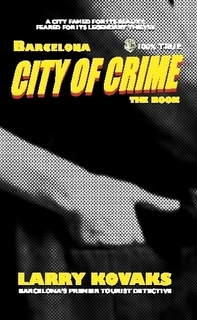
Review: Barcelona – City Of Crime by Larry Kovaks

Barcelona - City Of Crime

Barcelona has something of a reputation when it comes to crime. Which is what you’d expect from any Mediterranean city packed to the rafters with tourists, sailors, hookers and grifters. It’s not exactly a dangerous place (Barcelona has a very low homicide rate) but plenty of bags get stolen and plenty of people get gypped. And that’s exactly why this city needs someone like Larry Kovaks whose latest (and first) book, City Of Crime, tells the story of one man’s fight against the ne’er-do-wells and miscreants (‘gypmeisters’) of the Ciutat Vella.

Consisting of a series of stories set in Barcelona’s old quarter, City Of Crime introduces the reader to the scams, tricks and mischief that take place right under any visitor’s nose. From illicit Chinese brothels (one has recently opened here in Cerdanyola, so the flyposted adverts say) to villainous dwarves, Kovaks lays bare the criminal heart of the city as well as its sordid underbelly, all in the gravelly voice of an American b-movie detective.

Kovaks, both the author and the star of the book (though I suspect that editor Andrew Minh deserves some praise for his work on the text), is an impressive beast of a man. His girth is only outsized by his quick wit (for the most part) and possibly his disgust with the bad boys and girls of Barcelona’s underworld. Fuelled by Ducado cigarettes, Voll Damm beer and Mascaró brandy, Kovaks fearlessly confronts the Tracksuit Mafia through the cold, piss-streaked streets of the Raval, like an 18-stone angel.

Much of the material in City Of Crime has been published on the web, both at Kovaks’s own website and in the pages of The New Entertainer. However, that shouldn’t deter readers from buying the printed edition which is attractively bound and features a brand new installment, The Danger Of The Perfect Brunette. My only criticism of the book would be that some of the earlier stories are somewhat short: this is a character who really comes into his own in the longer episodes.

A joy for residents of the Catalan capital and a forewarning for visitors, City Of Crime left me hungry for more. We can only hope that Kovaks, wherever he may be, gives us more of the goods in future editions.

Barcelona – City Of Crime by Larry Kovaks – 1/1
Buy the book online from Lulu here.

Primavera Sound 2010 Festival Line Up

It’s that time of year again! As Barcelona’s winter continues to fling a surprising array of nastiness at us, we’re already getting the occasional day that lets us dream of spring. And spring in Barcelona means one thing: the Primavera Sound festival. This year’s festival takes place from the 27th to the 29th of May, at the Parc del Fòrum.

This is the line up so far. It’s pretty much final, though a few more acts will likely be named. The big names so far appear to be The Charlatans, The Fall, Gary Numan, Orbital, Pet Shop Boys, Pixies, Wilco and Wire.

A Sunny Day In Glasgow
Apse
Atlas Sound
Beach House
Beak>
Ben Frost
Best Coast
Bigott
Bis
Biscuit
Black Lips
Black Math Horseman
Boy 8-Bit
Broken Social Scene
Built To Spill
Camaron, La Leyenda Del Tiempo
Circulatory System
CocoRosie
Cohete
Cold Cave
Condo Fucks
Crocodiles
Delorean
Diplo
Dr. Dog
Dum Dum Girls
Emilio José
Endless Boogie
Fake Blood
Florence + The Machine
Fuck Buttons
Ganglians
Gary Numan
Grizzly Bear
Half Foot Outside
HEALTH
Here We Go Magic
Hope Sandoval & The Warm Inventions
Japandroids
Jeffrey Lewis & The Junkyard
Joker featuring Nomad
Junip
Lee “Scratch” Perry
Les Savy Fav
Lidia Damunt
Liquid Liquid
Low performing “The Great Destroyer”
Major Lazer
Marc Almond
Matt & Kim
Mission Of Burma
Moderat
Monotonix
Mujeres
Nana Grizol
No Age
Nueva Vulcano
ODDSAC
Orbital
Owen Pallett (Final Fantasy)
Panda Bear
Pavement
Pet Shop Boys
Pixies
Polvo
Real Estate
Roddy Frame
Scout Niblett
Seefeel
Shellac
Sian Alice Group
Sic Alps
Sleigh Bells
Spoon
Standstill
Sunny Day Real Estate
Superchunk
Surfer Blood
The Almighty Defenders
The Antlers
The Big Pink
The Bloody Beetroots Death Crew 77
The Books
The Bundles
The Charlatans performing “Some Friendly”
The Clean
The Drums
The Fall
The Field
The King Khan & BBQ Show
The New Pornographers
The Psychic Paramount
The Slits
The Smith Westerns
The Wave Pictures
The XX
Thee Oh Sees
Titus Andronicus
Tortoise
Ui
Wilco
Wild Beasts
Wild Honey
Wire
Yeasayer

More movie reviews

We’ve seen quite a few movies recently, including some old favourites and even a couple of classics I’d not seen before. Here is a quick binary review of the ones I can remember.

Casablanca – 1/1 – Shamefully late to see this for the first time. Good fun, nicely filmed and quite exciting.

The Men Who Stare At Goats – 0/1 – Perplexingly pointless, utterly without direction, basically crap. Did not finish.

Hulk (2003) – 1/1 – Epically misunderstood, awesome on Blu-ray and far better than the shoddy 2008 remake. More on this another time.

Brief Encounter – 0/1 – Couldn’t watch this without waiting for the punchline for a joke that never came. A victim of the many excellent parodies that followed it.

Up – 1/1 – Not as good as Wall-E but still v enjoyable. Loved the tearjerker opening sequence. Forgivable schmaltz.

Looking For Eric – 1/1 – Heartwarming comedy about workers’ solidarity and Eric Cantona.

Let The Right One In – 1/1 – Swedish film about friendship by way of vampirism. Not too vampirous.

My Mongetes a la Catalana recipe

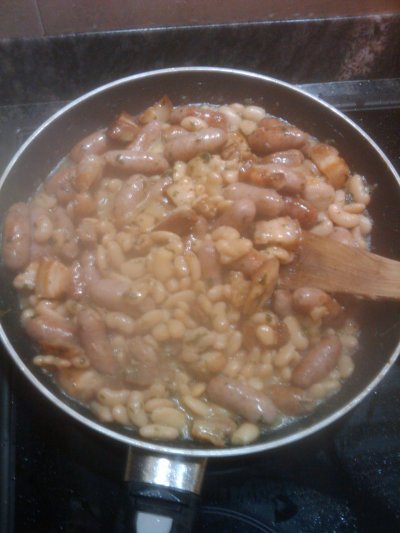
Catalan food, as observed by my friend Sebina, can be a little heavy sometimes. This mainly comes down to a love of recipes involving beans, especially in conjunction with lots of pork products. A classic combination is Botifarra amb Mongetes, sausage and beans… but that’s a tad dull if you ask me. Instead, I prefer ‘Beans a la Catalana’, made with either mongetes (big white beans) or fabes (young green broad beans). This is my made up recipe for Mongetes a la Catalana, another great rustic dish for wintry days and evenings. The measures are based on serving four or five people.

What you will need:

About 700g of good Mongetes blanques. Go for ‘ganxet’ type as these seem to be better. When I say 700g, I mean when they’re still in their water, in the jar. Strain them but do not wash them.
3 strips of good panceta/cansalada/pork belly, cut into large postage stamp-sized pieces. Not too large, mind
Sausage. Go for about 400g of botifarra sausage (chopped up as well). I used some mini chipolatas with black truffle but I don’t know how easy these are to come by
2 cloves garlic, minced (or whatever you call it)
Handful of chopped parsley
Dash of white wine
Salt
Good olive oil
About 15 mins

What you need to do:

Heat a nice amount olive oil to medium-high temperature (around level 5 on my cooker) in a large, heavy frying pan. Add the panceta, making sure to add plenty of salt (it’ll be a bit tasteless otherwise). After a minute or two, add the sausages. Fry the meat for 5-10 minutes, until it browns. Ensure the oil doesn’t get too hot and that the meat doesn’t burn. It might well spit a bit at this point (the fatty panceta does like to ‘pop’ from time to time). When browned, remove the meat with a slatted device, and place in a bowl.

Let the oil cool down a little bit before continuing. Get the heat down to medium/medium-low.

Now throw the garlic and parsley into the pan. If you got the oil temperature right, it’ll fry but not burn immediately (that happened to me the first time I tried this). Fry for about a minute. Now add the strained beans and stir together for another minute. Here, I like to add a dash of white wine, just to provide a bit of liquid to the dish. Don’t add more than a glass. When the wine has reduced down, add the meat again. Cook it all together for about four or five minutes (keeping the heat really low), and that’s it.

Serve a fairly small portion in a bowl with pa amb tomaquet and a glass of decent red wine. This dish is filling, warming and really yummy. Hope you enjoy it!

Avatar: Is this what we’ve come to?

Last night, Gemma, Jon and I went to see James Cameron’s new movie, Avatar. I don’t usually go to see big-budget blockbusters at the cinema but with all the hype that had built up around this film (pernicious hype!), I’d started to think that if I didn’t see it on the big screen, I might regret it in years to come. It is, after all, far better to regret that you wasted time doing something than it is to regret sitting on your arse at home, reading a good book and drinking some good red wine. Or something like that.

We saw Avatar at the Yelmo Cineplex Icària, near the Ciutadella metro stop. The Icària cinema is one of those awful new-style multiplex joints with 15 fairly small screens. Nowhere near as atmospheric or impressive as the Odeon or Cannon of my youth in Plymouth. But the seats are more comfortable. The tickets cost €10.50 (Estafadors!), apparently because the film was popular. We were each given a pair of heavy, highly tinted sunglasses as we took our seats: these would make the 3-D work.

Yes, that’s right: Avatar is a movie which employs that most current of fads: pretend 3-D. Touted by many idiots in the film industry as being ‘as important as colour!’, pretend 3-D essentially makes the background a bit blurry while whichever character is in the foreground looks a bit shiny. More on this later.

The film itself is incredibly bad. Everything about it is bad. That is to say, it has absolutely no redeeming qualities whatsoever. The storyline is basically Pocahontas with more explosions. The script is unbelievably explanatory – at no point was the viewer able to question what might be happening, because everything had been clumsily foreshadowed in the first 25 minutes. The acting was melodramatic and amateurish. The ‘goodies’ were flawlessly ‘good’, the baddies seemed like they were involved in some sort of excruciating self-parody. Except they weren’t. There wasn’t a single moment of intended humour, soul or suspense – all in a film that lasted three hours. Three long, dull hours.

“Rubbish”

As I mentioned, the story is effectively Pocahontas: invading outsider meets beautiful warrior princess, they fight then become friends, she introduces him to her dad (the king), and her betrothed one (a warrior); no one likes the invader but he proves himself by undergoing their initiation rites; invader has sex with princess; invader’s fellow invaders turn up, intent on killing everyone; invader decides to be warrior, fights on the side of the tribe, big battle ensues, invader and princess survive, FIN.

Not that there’s anything particularly wrong with that: it’s an old story which, when done properly, can be very moving. The problem with Avatar is that James Cameron failed to do anything about the fact that we already know this story. So nothing happened that you couldn’t predict from the beginning.

The film has been praised in other reviews for the richness of its visuals and the lush imaginary landscapes which Cameron invented for the land of Pandora (yes, Pandora). Actually, the visuals were not particularly stunning and watching the Blu-ray of the BBC’s Planet Earth allows you to experience stunningly beautiful and far more detailed landscapes and forests… and it’s all real!

Other annoying aspects of the film include: the annoying American insistence on rousing speeches just before a confrontation (cf. Independence Day, a movie that at least had some humour) – the main character’s pre-battle speech in Avatar wouldn’t have sounded out of place had it been barked by George W. Bush. Sigourney Weaver, who I once thought was a great actress, proves that like most actors she’s actually not that bright and prefers $$$ to quality. Near-constant music. Action scenes that lack any excitement. 3-D.

“Pointless”

The very idea of making films in ‘3-D’ is flawed. As has been pointed out, we are not dogs. As humans, most of us are capable of seeing a flat image and perceiving depth. It’s why we have films in the first place. And anyway, 3-D in films isn’t 3-D at all. It’s 2-D with an effect applied to it. It can’t touch you and it is no more ‘realistic’ or thrilling than standard 2-D. As well as these systematic flaws, Cameron clearly didn’t want to be accused of just employing a gimmick, giving the audience cheap thrills by making objects jump out of the screen at them. So he didn’t have any of that in the film. Surely, if 3-D is to have a point, it’s to make stuff jump out of the screen at you?!

Instead, the pretend 3-D in Avatar is done more ‘subtly’, making characters in the foreground appear more defined than what’s going on in the background. What this means is that the cheap trick of messing with depth of field in order to stop the viewer from seeing into the distance, finds its zenith in Avatar. At no point are you really able to enjoy the visuals. At no point does the ‘camera’ slow down enough to take in any of the allegedly stunning vistas. What’s worse is that because you’re forced to wear these heavy, uncomfortable corrective spectacles all the way through the film (I took mine off quite a lot, though, as it seemed to have little effect on my enjoyment), there are plenty of parts of the film that are actually not 3-D at all. When you see these scenes through the glasses, what you see is a hell of a lot of shimmering and glitching that simply should be there.

And that’s the funniest thing about Avatar: the film that was supposed to bring 3-D to life for cinema audiences, like Gone With The Wind or the Wizard Of Oz did for colour, actually confirms 3-D to be a technology that doesn’t look great and that we don’t need. I doubt that I’ll ever watch another film in 3-D – at least, not if I can help it.

thebadrash.com’s binary review: Avatar – 2009 – Dir. James Cameron. 0/1

Adam Curtis: It Felt Like A Kiss

I’ll be writing a post soon about the last ten years and the effect they’ve had on me. One of the very many things I have to be grateful for during this decade is discovering the films of Adam Curtis.

Curtis’s documentaries focus on the political and social history of the 20th century, criticising much of the psychological methods of power employed during those years. In The Power of Nightmares, Curtis illustrated how governments learned that the best way they could explain their worth to us in a post-cold war world was by building a new culture of fear directed at enemies which could never be defeated. The Trap investigates the various definitions of freedom and how these contrary views impacted on societies.

[youtube]http://www.youtube.com/watch?v=2tOYYztbLZo[/youtube]

It Felt Like A Kiss is instantly recognisable as a Curtis film (the Helvetica typeface, the often shocking archive footage, the powerful soundtrack). But it is significantly different to those I mentioned above. Detailing “how power really works in the world”, IFLAK eschews any narration beyond occasional visual prompts. The film is instead a tapestry of powerful images played over a soundtrack of some fantastic music from the 50s through to the 90s. Like some kind of amazing, extra-long pop video.

And in It Felt Like A Kiss, it’s the music that I most adore. Ranging from Roy Orbison to the Velvet Underground to the Phil Spector-produced title song, Curtis selects a phenomenal playlist of well known and more obscure pieces. The soundtrack reminded me of how much I loved some long-neglected albums, and finally got me to listen to a ton of ‘Wall of Sound’ records, many of which are of unimpeachable quality and beauty, however mad their producer is.

[youtube]http://www.youtube.com/watch?v=2LqcXszIrwY[/youtube]

The film cannot currently be obtained legally, so you’ll have to download it. I’m hoping that Curtis will release his documentaries on DVD some time soon (a box set of those would be fantastic). If you’d rather not download a film illegally, you can listen to much of the soundtrack on this Spotify playlist.